


Thin-walled pipes are widely used in industries that demand precision, cleanliness, and reliable fluid transmission. From pharmaceutical manufacturing and semiconductor production to food processing and aerospace engineering, these pipes play a crucial role in maintaining system efficiency and product purity.
However, processing thin-walled pipes presents significant manufacturing challenges. Because the pipe walls are relatively delicate, traditional cutting methods can easily cause:
Burr formation
Pipe deformation
Ovalization
Surface scratches
Heat damage
Inconsistent weld preparation
To overcome these issues, manufacturers increasingly rely on orbital cutting machines. These advanced pipe processing systems are specifically designed to deliver accurate, clean, and deformation-free cuts on thin-walled tubing.
This article explores how orbital cutting machines work, why they are ideal for thin-walled pipe processing, their key advantages, industrial applications, and how they improve production efficiency and welding quality.
Thin-walled pipes are tubes with relatively small wall thickness compared to their diameter. These pipes are commonly made from:
Stainless steel
Titanium
Duplex steel
High-purity alloys
Aluminum
They are widely used in applications requiring:
Lightweight construction
High corrosion resistance
Smooth internal flow
Hygienic operation
Precision welding
Typical thin-wall pipe applications include:
Pharmaceutical pipelines
Semiconductor gas delivery systems
Dairy and beverage processing
Aerospace hydraulic systems
Biotechnology equipment
Cleanroom piping networks
Because the walls are thin, even small cutting errors can compromise the entire system.
Processing thin-walled pipes is far more demanding than cutting thick-wall industrial piping. Several technical challenges must be carefully controlled.
Excessive clamping pressure or uneven cutting force can deform the pipe shape. This may result in:
Oval pipe ends
Poor fitting accuracy
Welding difficulties
Leakage risks
Thin-walled pipes are particularly vulnerable because they lack structural rigidity.
Traditional cutting methods often leave burrs on the pipe edges. Burrs can:
Contaminate clean systems
Restrict fluid flow
Cause welding defects
Require secondary deburring operations
In high-purity industries, even microscopic burrs are unacceptable.
Thermal cutting methods generate excessive heat that may:
Discolor stainless steel
Alter material properties
Reduce corrosion resistance
Create oxidation layers
Thin-wall tubing is especially sensitive to thermal distortion.
Manual cutting methods frequently produce:
Crooked cuts
Uneven end faces
Variable tolerances
This creates major problems during orbital welding or automatic assembly.
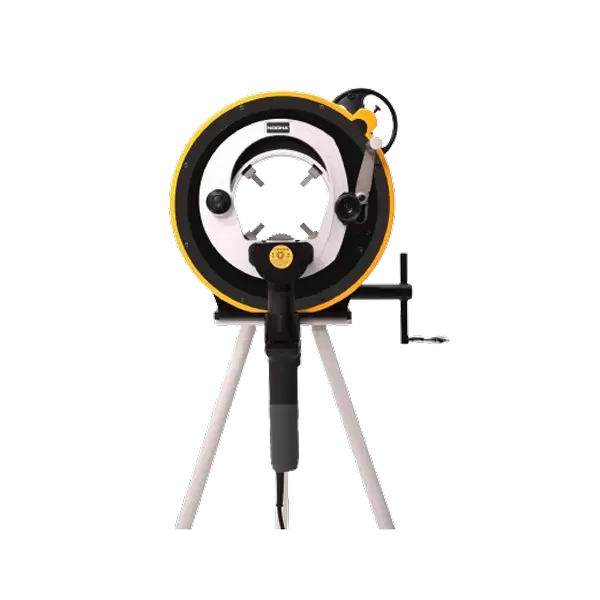
Orbital cutting machines are precision pipe processing systems that cut pipes using a rotating cutting head that moves around the pipe circumference.
Unlike conventional cutting systems where the pipe rotates, orbital cutting machines:
Keep the pipe stationary
Rotate the cutting blade around the pipe
Maintain consistent cutting pressure
Deliver highly accurate cuts
These machines are specifically engineered for:
Thin-wall stainless steel tubing
High-purity pipe systems
Weld preparation
Burr-free cutting applications
Orbital cutting machines offer several technological advantages that make them perfect for thin-walled pipe processing.
One of the biggest challenges in thin-wall pipe cutting is maintaining pipe shape during processing.
Orbital cutting machines use:
Self-centering clamps
Precision aluminum clamping jaws
Balanced holding systems
These features distribute pressure evenly across the pipe surface, preventing:
Crushing
Flattening
Surface marking
Oval deformation
The result is a perfectly round pipe end ready for welding.
Most orbital cutting machines use a cold cutting process rather than abrasive friction cutting.
Cold cutting offers several advantages:
No overheating
No oxidation
No discoloration
Minimal heat-affected zone
This is particularly important for stainless steel and high-purity alloy tubing, where surface quality directly impacts corrosion resistance and cleanliness.
For thin-walled pipes, cold cutting preserves the material structure and prevents thermal warping.
Orbital cutting machines are designed to produce smooth, clean pipe ends with little or no burr formation.
They achieve this through:
Controlled blade feed
Stable rotational cutting
Precision cutting geometry
Low vibration operation
Burr-free cutting is essential because thin-walled pipes are often used in:
Cleanroom environments
Pharmaceutical production
Semiconductor manufacturing
Any contamination caused by burrs could damage sensitive systems.
Orbital cutting systems deliver exceptional dimensional consistency.
Key accuracy benefits include:
Square cuts
Tight tolerances
Consistent end preparation
Repeatable production quality
This precision is critical when pipes must later undergo:
Orbital welding
Automatic assembly
Hygienic joining
Accurate cuts ensure better weld alignment and stronger weld integrity.
Traditional cutting methods often generate vibration that damages thin-wall tubing.
Orbital cutting machines use:
Rigid structural frames
Balanced rotating systems
Precision guide mechanisms
Low-vibration cutting helps achieve:
Smooth pipe surfaces
Clean cut edges
Reduced tool chatter
Higher surface quality
This significantly improves the final appearance and welding readiness of the pipe.
Orbital cutting machines improve manufacturing productivity by reducing manual operations.
Benefits include:
Faster cutting cycles
Reduced rework
Less deburring
Lower labor costs
Improved production consistency
In automated production environments, orbital cutting systems can be integrated into:
Pipe fabrication lines
Automatic welding systems
CNC processing stations
This enhances overall manufacturing efficiency.
Pharmaceutical piping systems require:
Hygienic surfaces
Crevice-free welds
High-purity stainless steel tubing
Orbital cutting machines ensure:
Clean cuts
No contamination
Consistent weld preparation
This helps manufacturers comply with strict GMP and FDA standards.
Semiconductor manufacturing uses ultra-high-purity gas pipelines where even microscopic particles can cause product defects.
Orbital cutting machines provide:
Particle-free cutting
Oxidation-free edges
Precision tubing preparation
This ensures maximum system cleanliness.
Thin-wall stainless steel pipes are widely used in hygienic food processing systems.
Orbital cutting machines support:
Sanitary pipe fabrication
Smooth internal surfaces
Easy cleaning capability
Burr-free cuts help prevent bacterial buildup inside the pipeline.
Aerospace hydraulic and fuel systems require:
Lightweight tubing
Precision tolerances
Reliable weld integrity
Orbital cutting machines deliver the accuracy necessary for aerospace-grade manufacturing.
Medical fluid systems and biotech processing equipment demand:
Clean internal flow
Corrosion resistance
Sterile processing environments
Orbital cutting technology helps maintain these strict standards.
When selecting an orbital cutting machine for thin-walled pipe processing, manufacturers should evaluate several important features.
Choose a machine compatible with your tubing dimensions.
Precision self-centering clamps are essential for deformation-free cutting.
Brushless motors provide:
Stable torque
Longer lifespan
Lower maintenance
High-performance blades improve:
Cutting smoothness
Tool life
Burr reduction
Portable orbital cutting machines are ideal for:
On-site installation
Field maintenance
Cleanroom operations
Advanced systems may include:
Digital controls
Programmable feed rates
Integration with orbital welding systems
| Feature | Orbital Cutting Machines | Traditional Cutting Methods |
|---|---|---|
| Burr Formation | Minimal | High |
| Pipe Deformation | Very Low | Common |
| Heat Damage | None or Minimal | Significant |
| Cutting Precision | Excellent | Variable |
| Weld Preparation | Directly Ready | Requires Rework |
| Surface Finish | Smooth | Rough |
| Production Consistency | High | Operator Dependent |
This comparison clearly demonstrates why orbital cutting technology has become the preferred solution for thin-wall tubing applications.
As manufacturing standards continue to rise, orbital cutting technology is evolving rapidly.
Future developments include:
Fully automated cutting systems
AI-assisted cutting parameter optimization
Smart quality monitoring
Integration with robotic welding
Enhanced digital process control
These innovations will further improve:
Cutting consistency
Production speed
Material utilization
Manufacturing efficiency
Thin-walled pipe processing requires an exceptional level of precision, cleanliness, and dimensional control. Traditional cutting methods often struggle to meet the strict requirements of industries such as pharmaceuticals, semiconductors, aerospace, and food processing.
Orbital cutting machines provide an advanced solution by delivering:
Burr-free cutting
Deformation-free processing
High dimensional accuracy
Excellent weld preparation
Consistent production quality
Through precision clamping systems, cold cutting technology, stable orbital motion, and low-vibration operation, orbital cutting machines have become an essential tool in modern thin-wall pipe fabrication.
As industrial manufacturing moves toward higher automation and stricter quality standards, orbital cutting machines will continue to play a critical role in ensuring efficient, reliable, and high-quality thin-walled pipe processing.

Mr. Jeff Huang
15251441199
Miss Doria Zhu
15102105304
Miss Jina Wang
18261592800








 Language
 Back
Back
 Prev
Prev
 Next
Next
 Aug 05,2026

 Leave a Message