


Wall thickness is a critical factor in pipe cutting, but it is often overlooked when manufacturers evaluate an orbital cutting machine. Buyers may focus first on pipe outside diameter, motor power, or cutting speed, while wall thickness quietly determines many of the actual cutting conditions.
A thin-walled tube and a thick-walled pipe can have the same outside diameter but require very different cutting strategies. The thin tube may be easier to cut because there is less material to remove, yet it is more vulnerable to deformation, excessive clamping pressure, vibration, and poor support. A thick-walled pipe is usually more structurally stable, but it places greater demands on cutting power, tooling, feed control, and machine rigidity.
For this reason, wall thickness should be considered together with pipe diameter, material, tooling, cutting parameters, and the required finished quality. This is particularly important for manufacturers working with stainless steel tubing, precision process piping, and other applications where the pipe must be cut accurately and prepared for subsequent welding or assembly.
Understanding how wall thickness affects orbital cutting machines can help buyers select the right equipment and help operators establish more stable cutting conditions.
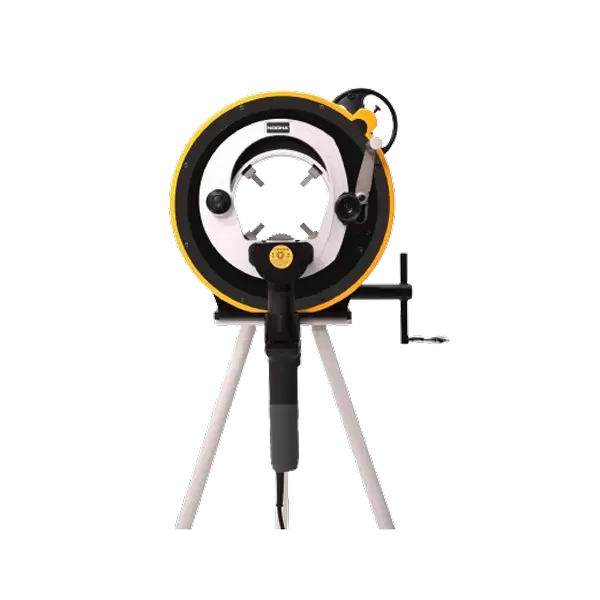
During orbital cutting, the cutting tool travels around the pipe while progressively removing material from the tube wall. The amount of material that must be removed depends heavily on wall thickness.
A thinner wall means a smaller cutting cross-section. This can reduce the resistance encountered by the tool, but it also means that the pipe has less material to maintain its shape.
A thicker wall presents a different situation. The pipe is generally more resistant to external deformation, but the cutting tool must remove more material, increasing the mechanical load on the equipment.
This creates two different challenges.
Thin-walled tubes are mainly sensitive to:
Clamping pressure
Pipe centering
Cutting force
Vibration
Pipe support
Tool condition
Feed control
The primary objective is to maintain the tube's original geometry while allowing the tool to cut smoothly.
Thick-walled pipes are more likely to challenge:
Motor capacity
Cutting tool durability
Machine rigidity
Feed control
Cutting efficiency
Heat management
The primary objective is to provide enough cutting capability without overloading the machine or tooling.
Therefore, wall thickness does not simply determine whether a pipe is "easy" or "difficult" to cut. It changes the type of challenges that the cutting system must manage.
Thin-walled tubes are common in applications where clean pipe ends, dimensional consistency, and high-quality welding preparation are important.
However, their relatively low structural rigidity makes them more sensitive to external forces.
When the wall becomes thinner, the pipe can be easier to compress or distort.
If the clamping system applies excessive pressure, the round tube may become slightly oval or flattened. Once this happens, the cutting tool is no longer working with the original geometry of the workpiece.
This can lead to:
Uneven pipe ends
Dimensional variation
Poor fit-up
Difficulty during welding
Additional finishing work
A well-designed orbital tube cutting machine should therefore provide stable workholding without unnecessarily compressing the tube.
A thin-walled tube does not necessarily require more cutting power. In many cases, the greater concern is controlling the forces applied to the workpiece.
The operator needs to pay attention to:
Clamping force
Tool sharpness
Feed rate
Cutting speed
Pipe support
Machine stability
Small changes in these conditions can have a noticeable effect on the final result.
Increasing wall thickness generally increases the amount of material that the cutting tool needs to remove.
This increases the cutting load and can place greater demands on the complete machine system.
The cutting tool must travel through a larger cross-section of material.
As a result, thick-walled pipe processing may require:
More cutting force
Stronger tooling
Higher motor capacity
More stable transmission
Controlled feed
Greater attention to heat generation
If the machine is not appropriately matched to the application, the cutting process may become slower or less stable.
When selecting an orbital pipe cutting machine, manufacturers should not only ask whether the machine can accommodate the pipe diameter.
They should also confirm the supported wall thickness for the specific material being processed.
A machine that can physically clamp a large-diameter pipe may not necessarily be optimized to cut its thickest wall.
This distinction is important when comparing different machines.
Cutting force is one of the most important links between wall thickness and machine performance.
As more material needs to be removed, the cutting tool generally encounters greater resistance.
However, cutting force is not determined by wall thickness alone.
It is also influenced by:
Pipe material
Tool geometry
Tool sharpness
Cutting speed
Feed rate
Pipe diameter
Machine rigidity
Motor characteristics
For example, a relatively thin stainless steel tube may have very different cutting behavior from a thicker tube made from a harder alloy.
This is why an experienced orbital cutting machine manufacturer should evaluate the complete application instead of recommending equipment based on one specification.
The cutting tool is directly involved in the material-removal process, so wall thickness must be considered when selecting tooling.
A tool suitable for thin-walled tubing may not provide the same performance when used for significantly thicker material.
For thin-wall applications, the objective is controlled and efficient material removal.
A suitable cutting tool can help minimize unnecessary force on the pipe and reduce the risk of:
Deformation
Burrs
Vibration
Excessive heat
Poor surface finish
Tool sharpness is particularly important. A worn cutting edge can increase resistance and make a thin tube more difficult to process smoothly.
Thicker walls place greater demands on tool durability.
The cutting edge must remain effective while removing a larger amount of material. If the tool is not appropriate for the application, wear can accelerate and cutting resistance can increase.
For manufacturers using orbital cutting machines across multiple pipe specifications, maintaining suitable tooling for different wall thickness ranges can improve both consistency and productivity.
Wall thickness also influences the cutting speed that can be used effectively.
A thin-walled tube contains less material across the cutting section, so the cutting process may be completed more quickly under suitable conditions.
A thick-walled pipe generally requires the tool to remove more material, which can require more controlled cutting conditions.
However, faster is not always better.
If the cutting speed is too aggressive for the wall thickness and material, the result may include:
Increased cutting force
Excessive vibration
Higher tool wear
Poor cut quality
Greater heat generation
Conversely, cutting too slowly can reduce productivity and may increase the time that the tool remains engaged with the material.
The appropriate cutting speed should therefore be determined by the relationship between wall thickness, material, tooling, and machine capability.
Feed rate determines how quickly the cutting tool advances through the material.
When cutting a thick-walled pipe, excessive feed can place a significant load on the cutting tool and drive system.
When cutting a thin-walled tube, excessive feed can also be problematic because the pipe itself may not have enough structural rigidity to resist the resulting forces.
The objective is controlled material removal rather than simply maximizing feed speed.
A stable orbital cutting machine should allow the operator to establish a feed condition that matches the actual workpiece.
For production environments, consistent feed control can also reduce variation between individual pipe sections.
One of the most important differences between thin- and thick-walled pipe processing is deformation behavior.
A thick wall generally provides greater resistance to external forces. A thin wall has less structural support and can therefore change shape more easily.
If a thin-walled tube is clamped too aggressively, the tube may be compressed before cutting even starts.
This means deformation can sometimes be caused by the workholding system rather than the cutting tool.
The clamping system should hold the tube securely while distributing the force appropriately.
Even when the clamping force is correct, cutting forces can influence a thin-walled tube.
If the tool encounters excessive resistance, mechanical forces can be transferred into the workpiece.
This is why deformation control should be considered when selecting an orbital tube cutting machine for thin-wall applications.
Correct centering becomes particularly important when processing thin-walled tubing.
If the pipe is not positioned correctly, the cutting tool may encounter different wall conditions around the circumference.
This can result in inconsistent cutting resistance and an irregular finished edge.
A self-centering clamping system can help maintain a more consistent relationship between the pipe and cutting head.
However, the machine's clamping mechanism is only part of the solution. The operator must also ensure that the tube is correctly inserted, seated, and supported.
Machine rigidity becomes increasingly important as cutting forces increase.
For thick-walled pipes, the cutting system must withstand greater mechanical loads while maintaining the correct relationship between the tool and workpiece.
If the machine structure or mechanical components are not sufficiently stable, vibration may occur.
Vibration can contribute to:
Uneven cutting
Tool wear
Rough pipe ends
Reduced repeatability
Increased cutting resistance
A robust orbital pipe cutting machine should therefore provide sufficient structural stability for its intended wall-thickness range.
Vibration is not caused by wall thickness alone, but wall thickness can influence how the workpiece responds to cutting forces.
Thin-walled tubes can sometimes vibrate more easily because their structure is less rigid.
Thick-walled pipes may resist workpiece vibration better, but the higher cutting forces involved can place greater demands on the machine.
Potential sources of vibration include:
Poor clamping
Incorrect cutting parameters
Worn tools
Loose mechanical components
Inadequate pipe support
Insufficient machine rigidity
For consistent results, operators should consider the pipe and machine as one complete cutting system.
Pipe support becomes particularly important when processing long tubes.
A thin-walled tube can be more flexible, making it susceptible to bending or movement under its own weight.
If the pipe shifts during cutting, the relationship between the workpiece and cutting tool can change.
This may affect:
Cutting accuracy
Pipe roundness
Cut squareness
Surface quality
Repeatability
Additional supports or fixtures can help maintain the pipe's position.
When using orbital cutting machines, support should be planned according to pipe length, diameter, wall thickness, and material rather than relying only on the machine's built-in clamping system.
Wall thickness also has an indirect effect on thermal conditions during cutting.
A thicker wall means that more material must be removed, potentially increasing the amount of energy transferred into the cutting process.
If cutting conditions are poorly matched, excessive heat can contribute to:
Tool wear
Surface changes
Reduced tool life
Dimensional instability
Lower cutting consistency
Heat generation is influenced by many factors, including material, tool condition, cutting speed, feed rate, and machine configuration.
Therefore, wall thickness should be considered as part of a larger parameter set rather than treated as an isolated variable.
Stainless steel is widely used for applications requiring corrosion resistance, cleanliness, and reliable mechanical performance.
It is also an important material for precision tube processing.
When selecting a stainless steel pipe cutting machine, buyers should provide both material information and wall-thickness requirements.
Different stainless steel grades can behave differently during cutting, while changes in wall thickness can alter cutting resistance and workpiece stability.
For thin-walled stainless steel tubes, deformation control and clamping become especially important.
For thicker stainless steel pipes, cutting capacity, tooling, and machine rigidity become more significant.
This demonstrates why simply specifying "stainless steel" is not enough when requesting an equipment recommendation.
Pipe diameter and wall thickness should always be evaluated together.
Consider two pipes with the same outside diameter. One may have a relatively thin wall while the other has a substantially thicker wall.
Their cutting behavior can be completely different.
The thin-walled version may require greater attention to:
Clamping
Support
Centering
Deformation
The thick-walled version may place greater demands on:
Motor power
Tooling
Feed control
Machine rigidity
Therefore, machine selection should be based on:
Outside diameter + wall thickness + material + cutting requirements
This combination gives an orbital cutting machine supplier a much clearer understanding of the actual application.
Wall thickness should be included in the initial machine-selection process rather than considered only after equipment has been purchased.
Buyers should pay particular attention to:
Clamping design
Self-centering capability
Deformation control
Cutting accuracy
Tool options
Pipe support
Machine stability
A machine with high cutting power is not automatically the best choice if the main application involves delicate thin-walled tubing.
The priorities may shift toward:
Cutting capacity
Motor power
Machine rigidity
Tool durability
Feed control
Continuous operating capability
Heat management
The machine should be capable of handling the required wall thickness without excessive strain.
Several common mistakes can reduce cutting performance.
A machine's diameter range does not tell the whole story.
The supported wall thickness must also match the intended application.
Thin-wall tubes may require less cutting force but can be more difficult to hold and cut without deformation.
Different wall thicknesses may require different combinations of speed, feed, and tooling.
A worn tool can increase cutting resistance and affect performance even when the machine itself is operating normally.
Long, thin-walled tubes can move or sag during processing if they are not properly supported.
If the thickest pipe specification is already close to the equipment's maximum capability, there may be less operating flexibility for production.
Manufacturers processing a wide range of tubes can improve consistency by establishing application-specific cutting procedures.
Maintain appropriate cutting tools for different pipe materials and wall thicknesses.
Develop clear clamping procedures for thin- and thick-walled tubing.
Determine suitable speed and feed conditions for different combinations of material and wall thickness.
Inspect cutting tools regularly and replace worn components before cutting quality declines.
Check clamping systems, bearings, transmission components, guides, and other mechanical parts for wear or looseness.
Use appropriate external support when the workpiece length or flexibility requires it.
These measures help orbital cutting machines deliver more consistent performance across a wider range of pipe specifications.
When contacting an orbital cutting machine supplier, buyers should provide more than the pipe's outside diameter.
Useful information includes:
Minimum pipe diameter
Maximum pipe diameter
Minimum wall thickness
Maximum wall thickness
Pipe material
Pipe length
Required cutting accuracy
Required cut quality
Production volume
Cutting frequency
Whether beveling is required
Manual or automated operation
This information allows the supplier to evaluate the complete application.
It also reduces the risk of selecting a machine based on a single specification that does not represent actual production requirements.
Choosing equipment according to the actual wall-thickness range can improve more than cutting quality.
It can also influence overall production efficiency.
When the machine, tooling, and parameters are properly matched, manufacturers can potentially achieve:
More consistent cutting
Lower tool wear
Reduced deformation
Better repeatability
Fewer rejected components
Less manual finishing
More predictable production cycles
For manufacturers processing multiple tube specifications, this matching process can be particularly valuable.
Wall thickness has a significant influence on orbital cutting performance because it changes both the mechanical behavior of the pipe and the demands placed on the cutting system.
Thin-walled tubes are generally more sensitive to clamping pressure, centering, support, vibration, and deformation. Thick-walled pipes usually require greater cutting capability, more durable tooling, stronger machine rigidity, and carefully controlled cutting parameters.
However, wall thickness should never be considered independently. Pipe diameter, material, cutting tool, feed rate, cutting speed, machine structure, clamping method, and production requirements all interact with wall thickness to determine the final cutting result.
For this reason, manufacturers should provide complete pipe specifications when selecting orbital cutting machines. Rather than choosing equipment based only on diameter or motor power, buyers should evaluate whether the complete machine configuration is appropriate for the actual wall-thickness range they need to process.
For thin-walled stainless steel tubes, deformation control and stable clamping may be among the most important considerations. For thicker industrial pipes, cutting capacity, tooling durability, and machine rigidity may become higher priorities.
Ultimately, the best orbital cutting machine is not simply the machine with the largest capacity or highest power. It is the equipment whose cutting system, tooling, clamping, and operating parameters are properly matched to the material, diameter, wall thickness, and production requirements.
By understanding how wall thickness affects cutting force, deformation, tooling, speed, vibration, and machine capacity, manufacturers can make more informed equipment decisions and achieve cleaner, more consistent, and more repeatable results from their orbital cutting machines.

Mr. Jeff Huang
15251441199
Miss Doria Zhu
15102105304
Miss Jina Wang
18261592800








 Language
 Back
Back
 Prev
Prev Next
Next
 Aug 20,2026
 Leave a Message