


Pipe deformation is one of the most common quality concerns when processing thin-walled tubes, particularly stainless steel pipes. Although an orbital cutting machine is designed to provide controlled and accurate cutting, the pipe can still become flattened, distorted, or slightly out of round if the cutting process is not properly matched to the workpiece.
For manufacturers, pipe deformation is more than a cosmetic issue. A distorted pipe end can make subsequent welding, fitting, assembly, or sealing more difficult. It can also affect dimensional consistency and increase the amount of manual finishing required.
The good news is that pipe deformation is usually not caused by one single factor. It is the result of several conditions working together, including excessive clamping force, unsuitable cutting tools, incorrect cutting parameters, inadequate support, pipe material, wall thickness, and machine setup.
Understanding these causes is essential when selecting and operating orbital cutting machines. By identifying the source of deformation and adjusting the cutting process accordingly, manufacturers can achieve cleaner cuts while preserving the original geometry of the pipe.
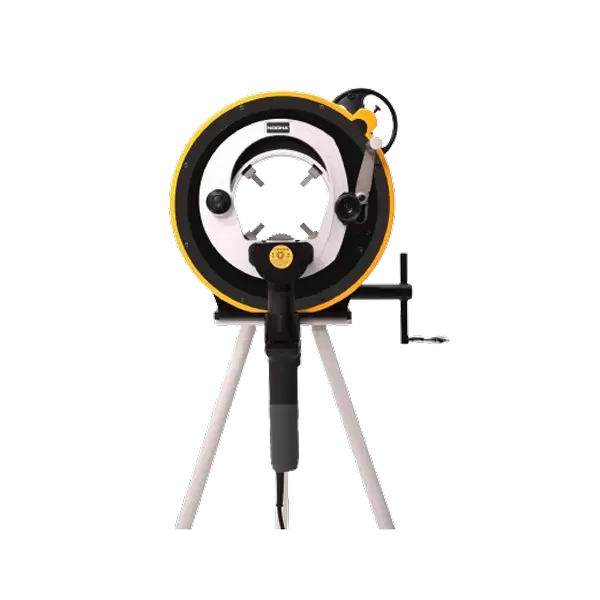
Pipe deformation refers to an unwanted change in the original shape or dimensions of a pipe during cutting.
A round tube may become slightly oval, flattened, dented, or distorted around the cutting area. In some cases, deformation may be visible immediately after cutting. In other situations, the pipe may remain visually acceptable but show dimensional changes that become apparent during assembly or welding.
Common forms of deformation include:
Flattening near the cutting area
Ovalization of the pipe
Local dents caused by clamping
Distortion of thin-walled tubing
Irregular pipe ends
Changes in the circular profile
Slight angular distortion
The risk is generally greater when processing thin-walled tubes because they have less structural resistance against external forces.
A properly selected orbital pipe cutting machine should provide stable clamping and controlled cutting to minimize these problems, but the machine must still be correctly configured for the specific pipe being processed.
One of the most common causes of pipe deformation is excessive clamping pressure.
The clamping system needs to hold the pipe firmly enough to prevent movement during cutting. However, if the force is too high, especially on thin-walled tubing, the pipe wall can be compressed.
This can result in:
Flattened sections
Local dents
Oval-shaped pipe ends
Permanent deformation
This problem is particularly important when processing thin-walled stainless steel tubes.
A professional orbital tube cutting machine should provide a clamping system that balances stability with deformation control. The objective is not to clamp the pipe as tightly as possible. Instead, the goal is to apply sufficient and evenly distributed force to prevent movement without damaging the tube.
Operators should therefore follow the manufacturer's recommended clamping procedure rather than relying on excessive pressure to secure the workpiece.
Wall thickness has a major influence on how a pipe reacts to cutting and clamping forces.
A thick-walled pipe generally has greater structural rigidity and can resist external forces more effectively. A thin-walled tube, however, can deform much more easily.
This means the same clamping pressure that works well for a thick pipe may be excessive for a thin-walled tube.
When selecting orbital cutting machines, buyers should provide the supplier with accurate information about:
Pipe outside diameter
Wall thickness
Pipe material
Pipe length
Required cutting accuracy
The machine should then be selected based on the complete combination of these specifications.
Simply knowing the pipe diameter is not enough to determine whether a particular machine configuration is appropriate.
Even when the clamping force is appropriate, the position of the clamps can affect pipe deformation.
If the workpiece is not properly seated in the clamping system, pressure may be concentrated in certain areas rather than distributed evenly around the pipe.
This can create localized deformation.
Improper clamping positioning may also allow the pipe to move slightly during cutting, creating another source of dimensional inconsistency.
Before operating an orbital cutting machine, the operator should make sure that:
The pipe is correctly positioned.
The pipe is properly centered.
The clamping components are correctly installed.
The workpiece is supported adequately.
The clamping force is appropriate for the pipe.
Correct positioning is especially important for small-diameter and thin-walled tubing.
An orbital cutting process depends on a stable relationship between the pipe and the cutting head.
If the pipe is not centered correctly, the cutting tool may not follow the intended cutting path evenly around the workpiece.
Poor centering can contribute to:
Uneven material removal
Irregular pipe ends
Increased cutting resistance
Localized deformation
Inconsistent wall thickness at the cut
Some orbital pipe cutting machines use self-centering clamping systems to improve workpiece positioning.
Self-centering mechanisms can help reduce positioning errors, but the operator still needs to ensure that the pipe is correctly inserted and supported before cutting begins.
Cutting itself generates mechanical force.
If the cutting tool encounters too much resistance, that force can be transferred into the pipe.
This is especially relevant when processing thin-walled tubing.
Excessive cutting force may result from:
An unsuitable cutting tool
A dull blade
Incorrect cutting speed
Excessive feed pressure
Cutting material that exceeds the machine's recommended capacity
Insufficient motor power
When the cutting force becomes too high, the pipe may experience local deformation rather than simply allowing the tool to remove material smoothly.
A properly configured orbital cutting machine should maintain controlled cutting forces appropriate for the material and wall thickness.
The condition of the cutting tool can have a significant effect on pipe deformation.
A sharp and properly selected cutting tool can remove material efficiently with controlled resistance.
A worn tool, by comparison, may require greater force to achieve the same result.
This can increase:
Cutting resistance
Heat generation
Vibration
Processing time
Mechanical stress on the pipe
Tool selection is equally important.
A blade designed for one material or wall thickness may not be suitable for another application.
When using orbital cutting machines, manufacturers should select cutting tools based on the pipe material, diameter, wall thickness, and machine configuration.
Regular tool inspection and timely replacement can help prevent deformation caused by excessive cutting resistance.
Cutting speed must be matched to the workpiece and cutting tool.
If the cutting speed is too aggressive for the pipe material and wall thickness, the cutting system may experience excessive resistance.
If the speed is too slow, the tool may remain in contact with the material longer than necessary, potentially increasing heat generation and affecting productivity.
The appropriate cutting speed depends on factors such as:
Pipe material
Wall thickness
Pipe diameter
Cutting tool
Motor characteristics
Machine design
There is no single cutting speed that is suitable for every pipe.
For this reason, operators should use the recommended parameters provided by the orbital cutting machine manufacturer and adjust them according to the actual application when appropriate.
Feed pressure is another important factor.
When operators apply too much force during manual cutting, the tool may be pushed aggressively into the pipe.
This can increase cutting resistance and create additional stress on the workpiece.
Thin-walled stainless steel tubes are particularly sensitive to this problem.
Controlled feeding allows the cutting tool to remove material progressively rather than forcing the tool through the pipe.
In automated orbital tube cutting machines, feed control can be more consistent because the process is governed by the machine's mechanical or electronic system.
For manual equipment, operator training becomes particularly important.
Pipe support becomes increasingly important as pipe length increases.
A long tube can bend or sag under its own weight if it is not properly supported.
This movement may affect the cutting area and create additional forces during processing.
Insufficient support can cause:
Pipe movement
Misalignment
Uneven loading
Cutting instability
Deformation near the cut
Additional supports, fixtures, or appropriate workholding arrangements can help maintain the pipe's position.
When planning an orbital pipe cutting operation, manufacturers should consider the entire workpiece rather than focusing only on the machine head.
Not all pipes respond to cutting forces in the same way.
Material properties such as hardness, ductility, elasticity, and thickness influence how the workpiece behaves during machining.
Stainless steel, for example, is widely used in precision tube applications, but different grades can have different cutting characteristics.
Aluminum is relatively lightweight and may behave differently under clamping pressure, while harder alloys can require greater cutting force.
Therefore, the machine configuration should be matched to the material being processed.
When purchasing a stainless steel pipe cutting machine, buyers should provide detailed information about the specific stainless steel grade whenever possible.
This allows the supplier to recommend appropriate cutting tools and operating parameters.
Pipe diameter and wall thickness have a combined influence on deformation.
A large-diameter pipe with a very thin wall can be surprisingly susceptible to deformation, even though its overall size is substantial.
Similarly, a small-diameter tube with a thick wall may be much more rigid.
Therefore, machine selection should not be based solely on outside diameter.
A supplier evaluating an orbital cutting machine should ideally consider:
Outside diameter + wall thickness + material + cutting requirements
This provides a much more accurate basis for selecting the machine and clamping configuration.
Machine rigidity can also affect deformation.
During cutting, the machine needs to maintain a stable relationship between the workpiece and cutting head.
If the machine structure or mechanical components allow excessive movement, vibration may occur.
Vibration can increase cutting resistance and affect the quality of the finished pipe end.
Potential causes include:
Loose components
Worn bearings
Insufficient structural rigidity
Poor clamping
Damaged cutting tools
Improper cutting parameters
A well-designed orbital cutting machine should provide a stable mechanical structure capable of handling the forces generated during normal operation.
Mechanical wear can gradually affect cutting performance.
Bearings, transmission components, clamping parts, guides, and other moving components may wear after prolonged operation.
When these components develop excessive play or movement, the cutting head may no longer maintain the same level of stability.
This can contribute to:
Uneven cuts
Increased vibration
Poor repeatability
Pipe movement
Deformation
Regular inspection is therefore essential.
Manufacturers should establish a maintenance schedule based on operating frequency and the recommendations of the orbital cutting machine supplier.
A machine can be technically capable of producing high-quality cuts but still deliver poor results if the setup is incorrect.
Before starting a cutting cycle, operators should verify:
Correct machine model and configuration
Correct cutting tool
Proper tool installation
Correct pipe positioning
Appropriate clamping
Adequate pipe support
Suitable cutting parameters
A standardized setup procedure can reduce operator-to-operator variation.
This is particularly useful for manufacturers that process different pipe sizes or materials throughout the day.
Orbital cutting is generally associated with controlled cutting processes, but heat can still be generated depending on the material, cutting tool, speed, and operating conditions.
Excessive heat may affect the pipe material and cutting tool.
Heat can become a concern when:
The tool is worn
Cutting resistance is high
The cutting parameters are unsuitable
The tool remains in contact with the material for too long
Proper tool selection and operating parameters can help control heat generation.
For precision applications, minimizing unnecessary thermal influence can contribute to better dimensional stability.
Using a machine outside its recommended operating range can significantly increase the risk of deformation.
For example, if a machine is intended for a particular diameter and wall thickness range, attempting to cut substantially thicker material may increase the load on the cutting system.
This can result in:
Excessive cutting force
Increased vibration
Slower cutting
Tool damage
Poor-quality pipe ends
Workpiece deformation
Therefore, buyers should always compare the actual pipe specifications with the manufacturer's recommended machine capacity.
A properly selected orbital tube cutting machine should provide enough capacity for the intended application without being unnecessarily oversized.
Preventing deformation starts with choosing the right machine and continues throughout the cutting process.
Here are several practical measures manufacturers can take.
Avoid excessive clamping force, particularly when processing thin-walled tubes.
The pipe should be secure but not compressed unnecessarily.
Make sure the pipe is properly positioned before cutting.
Self-centering clamping systems can help improve repeatability, especially when processing multiple pieces.
Use a blade or cutting tool suitable for the pipe material and wall thickness.
Inspect the tool regularly and replace it when necessary.
Cutting speed and feed should be appropriate for the specific material and dimensions.
Avoid using identical parameters for every type of pipe.
Long or flexible pipes should be properly supported to prevent movement and sagging.
Regularly inspect:
Clamps
Bearings
Cutting tools
Transmission components
Fasteners
Moving parts
Address unusual vibration or movement before it affects production quality.
Operators should understand how clamping pressure, cutting speed, feed, tooling, and pipe characteristics affect deformation.
Proper training can prevent many avoidable problems.
If deformation suddenly appears during production, do not immediately assume that the machine itself is defective.
A systematic inspection can help identify the actual cause.
Confirm the pipe's material, diameter, wall thickness, and dimensional consistency.
Check whether the pipe is centered and whether the clamping pressure is appropriate.
Look for wear, damage, incorrect installation, or unsuitable tooling.
Review cutting speed and feed settings.
Inspect the machine for loose or worn components.
Make sure the workpiece is adequately supported throughout the cutting process.
Confirm that the application falls within the recommended operating range.
This process can help manufacturers distinguish between problems caused by the workpiece, tooling, machine setup, and equipment itself.
If your primary application involves thin-walled stainless steel tubes, deformation control should be one of the key considerations when selecting equipment.
Instead of asking only about cutting speed or motor power, buyers should ask suppliers about:
Clamping design
Pipe centering
Minimum pipe diameter
Supported wall thickness
Cutting tool options
Deformation control
Machine rigidity
Cutting accuracy
Available accessories
A machine designed specifically for precision tube processing may provide a better solution than a general-purpose pipe cutter.
This is particularly important for applications where the cut pipe will be connected, welded, or assembled immediately after cutting.
Pipe deformation can create problems during subsequent welding operations.
If the pipe end is no longer properly round or square, it may be more difficult to achieve consistent alignment.
This can affect:
Joint fit-up
Welding preparation
Consistency between components
Production efficiency
Finished assembly quality
For applications requiring precise tube fabrication, controlling deformation during the initial cutting process can therefore reduce problems further down the production line.
This is one reason why professional orbital cutting machines are often preferred for applications where repeatability and pipe-end quality are important.
So, why does pipe deformation occur during orbital cutting?
The answer usually involves a combination of factors rather than a single problem. Excessive clamping pressure, thin pipe walls, poor centering, unsuitable cutting tools, excessive cutting force, incorrect cutting parameters, insufficient pipe support, vibration, material characteristics, and inadequate machine maintenance can all contribute to deformation.
The key to preventing these problems is to treat the cutting process as a complete system.
The machine, clamping mechanism, cutting tool, pipe material, wall thickness, cutting parameters, workpiece support, and operator technique must all work together.
When selecting orbital cutting machines, buyers should therefore look beyond basic specifications and evaluate how well the equipment matches their actual pipe-processing requirements. A properly configured orbital pipe cutting machine can help minimize deformation while delivering clean, consistent, and repeatable pipe ends.
For manufacturers processing thin-walled stainless steel tubes or other precision tubing, choosing the right orbital cutting machine manufacturer, using suitable tooling, maintaining proper clamping, and following recommended operating procedures can make a significant difference in cutting quality and overall production efficiency.

Mr. Jeff Huang
15251441199
Miss Doria Zhu
15102105304
Miss Jina Wang
18261592800








 Language
 Back
Back Prev
Prev
 Next
Next
 May 22,2025
 Leave a Message