


High-purity gas pipeline systems are the invisible backbone of many advanced industries, including semiconductor manufacturing, pharmaceuticals, biotechnology, aerospace, and specialty chemical processing. In these environments, even the smallest contamination particle or surface defect can lead to serious operational failures, product defects, or safety risks.
Because of these extremely strict requirements, every stage of pipeline fabrication must meet ultra-clean standards. Among all these stages, pipe cutting is one of the most critical. A poorly cut pipe end can introduce burrs, oxidation, micro-contamination, or dimensional inaccuracies that compromise the entire system.
This is why orbital cutting machines have become a core technology in high-purity gas pipeline fabrication. They provide precise, clean, and repeatable cutting performance that meets the demanding requirements of ultra-clean piping systems.
This article explores the role of orbital cutting machines in high-purity gas pipeline systems, their working principles, technical advantages, industry applications, and why they are essential for modern ultra-clean infrastructure.
High-purity gas pipeline systems are specialized networks designed to transport gases without introducing contamination. These gases may include:
Ultra-high purity nitrogen (N₂)
Argon (Ar)
Oxygen (O₂)
Hydrogen (H₂)
Specialty process gases used in semiconductor fabrication
These pipelines are widely used in:
Semiconductor fabs (wafer fabrication)
Pharmaceutical cleanrooms
Biotechnology production facilities
Laboratory gas distribution systems
Aerospace testing environments
The key requirement of these systems is simple but extremely strict:
The gas must remain chemically and physically pure from source to point of use.
Even microscopic contamination can lead to:
Semiconductor chip defects
Chemical reaction instability
Medical production failures
Equipment corrosion
Safety hazards
Therefore, every component of the pipeline must be manufactured under strict cleanliness control—including pipe cutting.
Pipe cutting is often underestimated, but in high-purity applications it is one of the most sensitive manufacturing steps.
Traditional cutting methods can introduce several problems:
Metal burrs inside or outside the pipe can:
Break off into the gas stream
Cause contamination downstream
Interfere with orbital welding
Trap particles and moisture
In ultra-clean systems, even microscopic burrs are unacceptable.
High-temperature cutting methods such as abrasive or thermal cutting can create:
Oxidized pipe edges
Discoloration
Altered material properties
These changes reduce corrosion resistance and increase contamination risk.
Inconsistent cutting can lead to:
Poor weld alignment
Gaps in pipe joints
Increased leak risk
High-purity systems require extremely tight tolerances.
Improper cutting tools may generate:
Metal particles
Dust and debris
Surface micro-fragments
These contaminants are extremely dangerous in semiconductor and pharmaceutical environments.
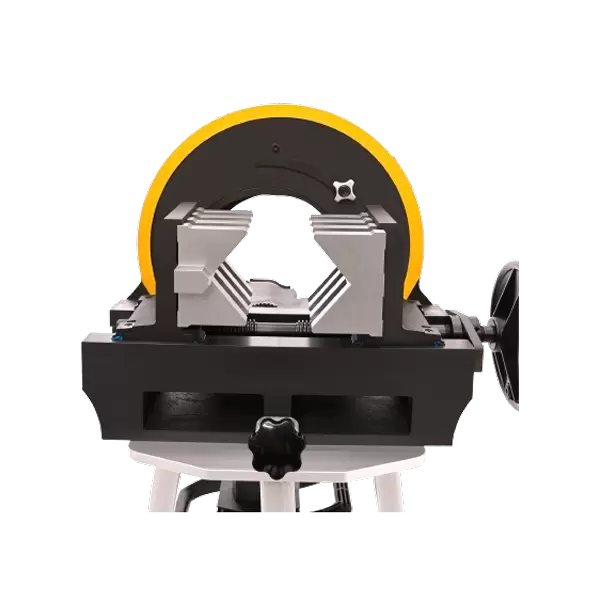
Orbital cutting machines are precision pipe cutting systems that operate by rotating a cutting head around a stationary pipe.
Instead of rotating the pipe (which can cause instability), the machine:
Holds the pipe firmly in place
Rotates the cutting tool 360° around it
Applies controlled feed pressure
Produces a uniform, clean cut
This design is ideal for high-purity applications because it ensures:
Stable cutting conditions
Minimal contamination risk
High dimensional accuracy
Burr-free pipe ends
Orbital cutting machines are specifically designed to meet the strict requirements of ultra-clean pipeline systems.
One of the most important advantages of orbital cutting machines is their ability to produce burr-free pipe ends.
This is achieved through:
Controlled rotational cutting motion
Precision blade engagement
Stable feed rate control
Low vibration operation
Burr-free cutting ensures:
No loose metal particles enter the gas system
Clean welding surfaces
Reduced risk of downstream contamination
In semiconductor and pharmaceutical industries, this feature is essential.
Many orbital cutting machines use a cold cutting process, meaning:
No excessive heat is generated
No thermal deformation occurs
No oxidation layer forms
This is extremely important because oxidation can:
Release particles into gas flow
Reduce corrosion resistance
Affect weld quality
Cold cutting ensures that the pipe retains its original metallurgical properties.
High-purity gas systems rely heavily on orbital welding after cutting. Therefore, pipe ends must be perfectly prepared.
Orbital cutting machines provide:
Square (90°) cuts
Minimal tolerance deviation
Smooth end surfaces
Consistent pipe geometry
This allows for:
Stronger orbital welds
Reduced welding defects
Improved system reliability
Pipe alignment is critical in high-purity systems.
Orbital cutting machines use self-centering clamps that:
Hold the pipe evenly
Prevent deformation
Maintain axial alignment
This ensures:
No oval pipe ends
No misalignment during welding
Uniform cutting pressure distribution
Unlike abrasive cutting tools, orbital cutting machines generate minimal debris.
This is because:
No grinding process is involved
Cutting is controlled and clean
Metal removal is precise rather than destructive
This significantly reduces contamination risk in cleanroom environments.
High-purity systems require consistency across long pipeline networks.
Orbital cutting machines ensure:
Identical cuts every time
Stable production quality
Reduced operator dependency
This is essential for large-scale semiconductor fabs and industrial gas distribution systems.
Semiconductor fabs require ultra-clean gas delivery systems for processes such as:
Photolithography
Etching
Deposition
Orbital cutting machines ensure contamination-free pipe preparation, supporting defect-free chip production.
Pharmaceutical production requires sterile gas and fluid systems.
Orbital cutting machines help ensure:
Hygienic pipeline construction
Compliance with GMP standards
Contamination-free processing environments
Biotech systems rely on sterile gas environments for:
Cell culture processes
Fermentation systems
Laboratory research
Clean pipe cutting is essential to maintain biological integrity.
Aerospace testing and propulsion systems use high-purity gases such as oxygen and nitrogen.
Orbital cutting machines ensure:
Leak-free pipeline joints
High structural reliability
Precision assembly
Research laboratories require flexible and ultra-clean gas delivery networks.
Orbital cutting ensures safe and contamination-free gas transport.
When selecting orbital cutting machines for high-purity gas systems, several features are critical:
Machines must handle:
304 stainless steel
316L stainless steel
Specialty alloys
Precise feed control ensures:
Smooth cutting surfaces
Minimal material stress
Some machines are designed for:
Low particle emission
Cleanroom operation standards
Portable orbital cutting machines allow:
On-site installation
Field pipeline construction
Maintenance operations
Cutting quality directly affects welding quality, so integration is important for:
Automated pipeline systems
High-precision fabrication lines
| Feature | Orbital Cutting Machines | Traditional Cutting |
|---|---|---|
| Burr Formation | Minimal | High |
| Particle Generation | Very Low | High |
| Oxidation Risk | None (cold cutting) | High |
| Dimensional Accuracy | Excellent | Inconsistent |
| Weld Preparation Quality | Ready for welding | Requires rework |
| Cleanroom Suitability | Yes | No |
This comparison clearly explains why orbital cutting machines are preferred in high-purity industries.
As industries move toward higher purity standards, orbital cutting technology continues to evolve.
Key trends include:
Fully automated cutting + welding systems
AI-based cutting parameter optimization
Smart contamination monitoring
Integration with digital factory systems
Advanced low-particle emission designs
These innovations will further improve reliability in ultra-clean pipeline construction.
High-purity gas pipeline systems demand extreme precision, cleanliness, and reliability at every stage of fabrication. Pipe cutting, though often overlooked, plays a critical role in ensuring system integrity.
Orbital cutting machines provide a superior solution by delivering:
Burr-free pipe cutting
Cold cutting without oxidation
High dimensional accuracy
Low particle generation
Perfect weld preparation
Through their advanced mechanical design and precision control systems, orbital cutting machines have become an essential tool in semiconductor, pharmaceutical, biotechnology, aerospace, and laboratory gas pipeline construction.
As industry standards continue to rise, orbital cutting machines will remain a cornerstone technology for building safe, efficient, and ultra-clean gas distribution systems.

Mr. Jeff Huang
15251441199
Miss Doria Zhu
15102105304
Miss Jina Wang
18261592800








 Language
 Back
Back
 Prev
Prev
 Next
Next
 Feb 18,2025
 Leave a Message